Roof and terrace waterproofing in Cyprus: what to check when viewing a home
Why does the Northern Cyprus climate stress roofs and terraces?
The TRNC Meteorological Department describes the climate of Northern Cyprus as subtropical Mediterranean: summers are hot and dry, winters are mild with little rain, and the rain is concentrated in the winter months. For a roof or terrace, this means a surface that sits in the sun for months and then takes most of its rain in just a few winter months.
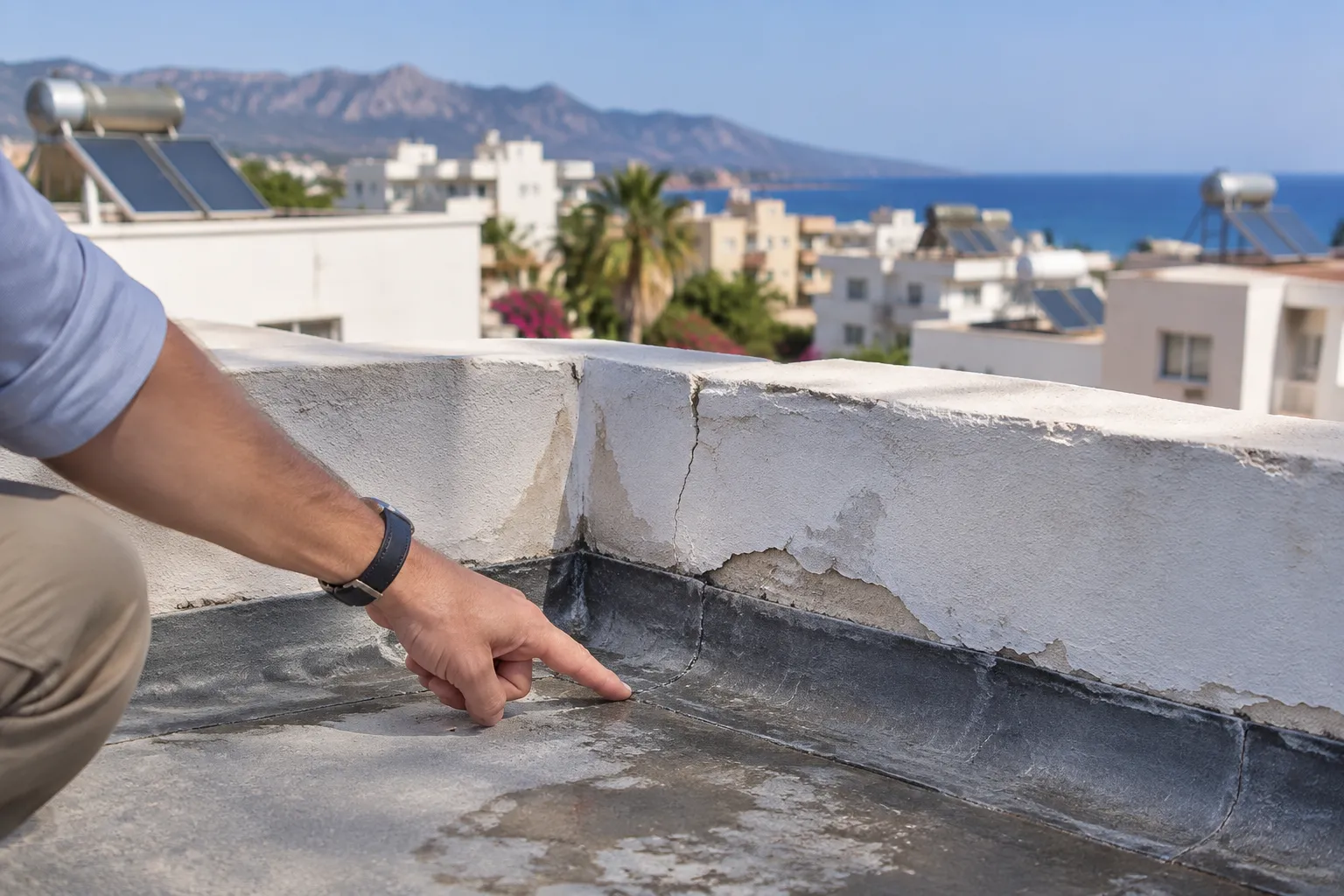
Through the summer, the sun wears down the surface covering, the joint filler and the waterproofing material. In dry weather this wear leaves no water marks, so it goes unnoticed. The slope of the terrace, the drain outlet and the wall junctions do their work in the winter months, when the rain collects. The first stain on a top-floor ceiling usually appears after several rainy days in a row.
Rainfall is not the same everywhere on the island. In the Meteorological Department’s 1991-2020 normals, the highest point rainfall was measured at Kantara and the lowest at Dörtyol; the values are in the table below. The two figures show that the rain a house receives varies by location within the same climate. The points to check on a roof are the same in every region.
| Measurement (1991-2020) | Value |
|---|---|
| Annual average temperature | 19.5 °C |
| Areal rainfall normal | 387.1 mm |
| Highest point rainfall (Kantara) | 559.2 mm |
| Lowest point rainfall (Dörtyol) | 274.1 mm |
What should you check on the roof and terrace at a first viewing?
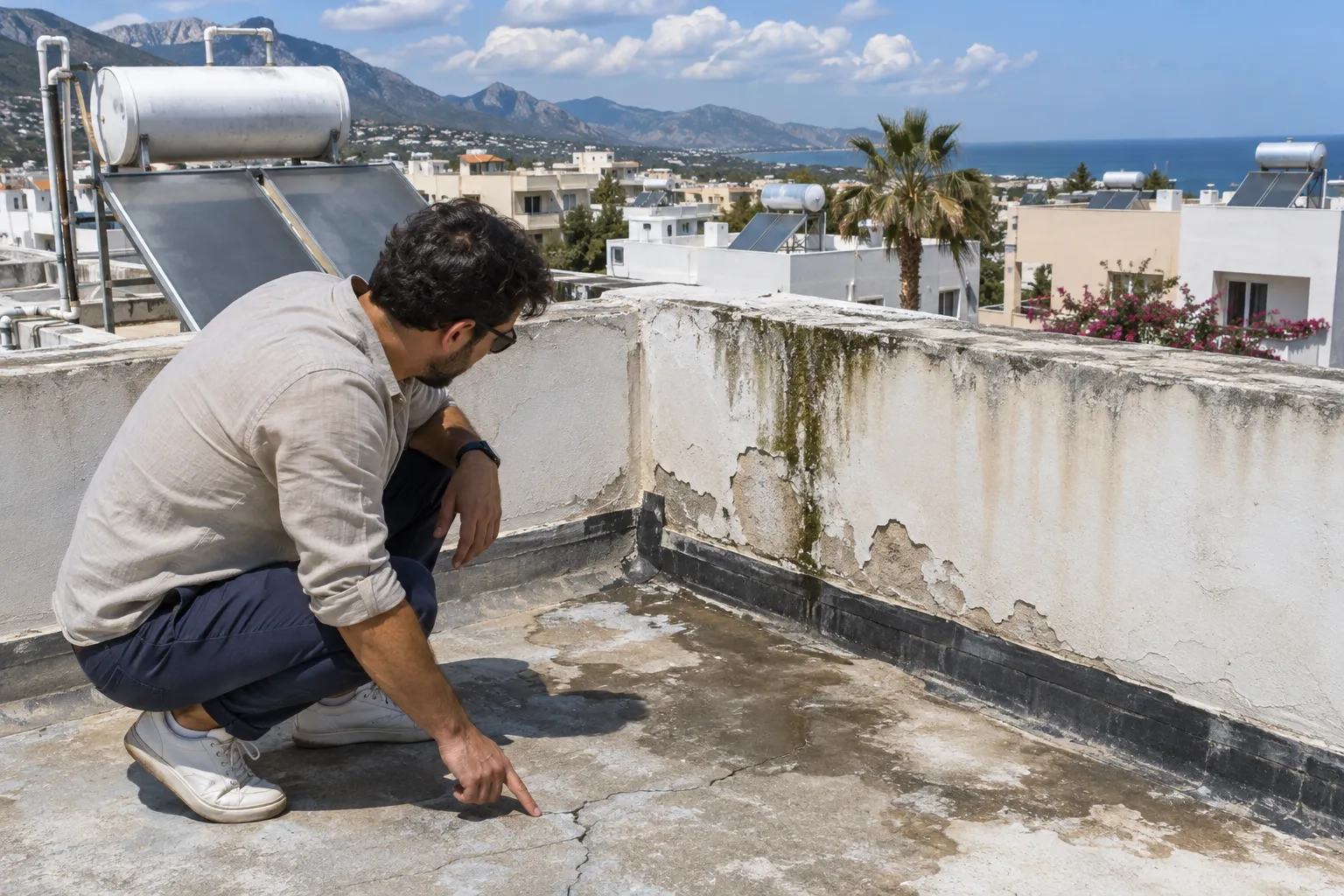
On a first viewing, the top-floor ceiling, the upper edge of the exterior walls and the terrace floor give the most information. A yellow ring, bubbling paint or crumbling plaster on the ceiling, and cracks, dirt rings or separation at the skirting on the terrace, are signs that water once got in or stood on the terrace.
The most telling part of a viewing is the ceiling of the top floor. A yellowish ring in the corners, bubbling paint or sand-like crumbling of the plaster is the trace of an old leak. A freshly painted ceiling in a room where everything else is old raises a question of its own.
On the terrace, look closely at the floor. Opened joints in the covering, separation from the wall at the base of the skirting and a dirt mark gathered in one corner show that water waits there. If the drain outlet is blocked with leaves and sand, water will look for another way even when the waterproofing is sound.
In the dry months, many of these marks are hidden. A second visit after the winter rains helps: January or February shows what an August visit leaves out.
- Yellow ring, bubbling paint or crumbling plaster on the top-floor ceiling
- A dark band or white salt mark at the upper edge of an exterior wall, under the parapet
- Cracks and opened joints in the terrace covering
- Standing puddles or dried dirt rings on the floor
- Separation at the junction of skirting and wall
- Whether the drain outlet is clear and whether the floor slopes toward it
- The surroundings of solar water heater legs, air-conditioning units and pipe penetrations
What are the waterproofing layers of a terrace and flat roof?
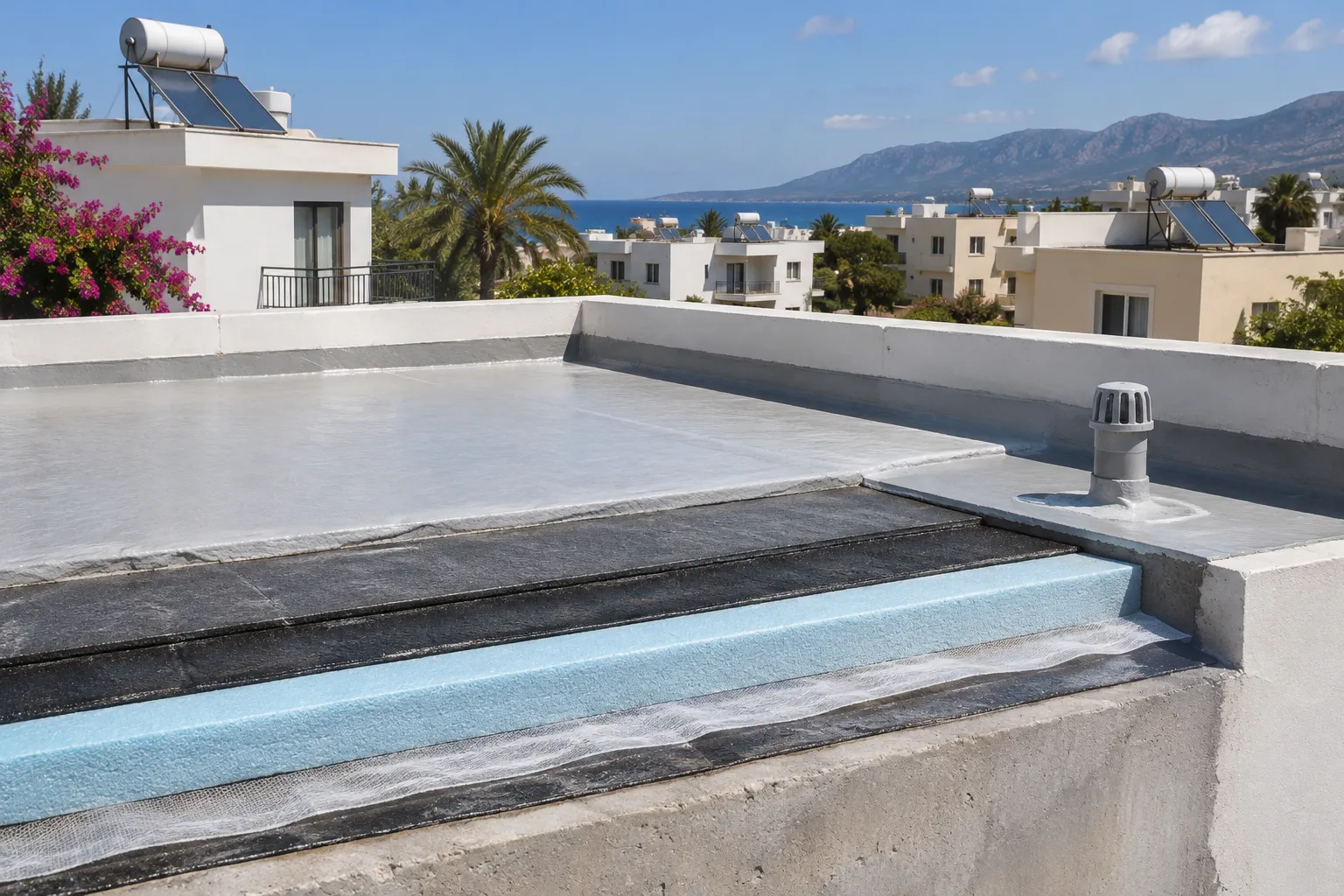
On a flat roof or terrace, waterproofing in most installations consists of several layers: on top of the structural concrete, a screed laid to a slope that directs water to the drain, over it a membrane or liquid-applied waterproofing, a layer that protects it, and the surface covering on top. Materials and order vary with the installer and the year of construction; what is described here is the general arrangement.
The reinforced concrete slab carries load; it is not there to stop water. The sloped screed on top runs rainwater toward the drain outlet. When the slope is insufficient, water collects on the terrace and the waterproofing stays wet for a long time.
The layer that stops water is the membrane or liquid-applied waterproofing. In many installations it is turned up a little at the base of walls and parapets, which is why separation at the base of the skirting draws attention. The drain outlet, the legs of the solar water heater, and air-conditioning and pipe penetrations are the places where the waterproofing is cut, and installers generally treat these points separately.
The protective layer shields the waterproofing from the sun and from the load of people walking on it, and the ceramic or stone covering hides it all. On a finished terrace the type of waterproofing cannot be told from outside, so the information has to come from the seller or from the installer who did the work.
- Surface covering
- Protective layer
- Waterproofing
- Sloped screed
- Reinforced concrete slab
How do you find out the lifespan and renewal cost of waterproofing?
The lifespan and renewal cost of waterproofing depend on the material, the workmanship, how exposed the roof is to the sun and how well the drains are maintained; there is no single figure that fits every home. Concrete information comes from an on-site inspection by a waterproofing installer and a written quote that describes the work item by item. When the quotes of two different installers are set side by side, it becomes clear where the difference comes from.
The timing of the inspection affects the result. After the winter rains, in January or February, the installer sees the wet spots directly; in August the same terrace looks dry and clean.
The price difference between two quotes usually comes from scope. If one includes removing the existing covering and clearing the debris and the other does not, the totals describe different jobs. A quote that lists the items below makes comparison possible.
- The date of the inspection and the problems seen on site
- Whether the existing covering will be removed
- The layers to be renewed: sloped screed, waterproofing, protective layer, covering
- Whether drain outlets, parapet bases and pipe penetrations are included in the work
- The approximate duration of the work and the season in which it will be done
- Who is responsible for debris removal and cleaning
- The total amount and the validity period of the quote
Questions to ask the seller
Three topics are put to the seller: when and by whom the waterproofing was done, whether there have been leaks in the past, and whether anything was added to the roof or terrace later. If there is a written trace such as an invoice, a quote or the installer’s name, it also becomes easier to reach the same person when maintenance is needed later.
A past leak is not by itself a negative sign; what matters is how it was dealt with. Painting over a stain that appeared on a bedroom ceiling in winter is a different job from opening the terrace and renewing the waterproofing.
Later additions deserve their own questions. A room enclosed on the terrace, pergola legs or a solar water heater placed on the roof afterwards all pierce the existing waterproofing.
The answers are best set against what you see on site. If the seller says there has never been a leak while a yellow ring sits on the top-floor ceiling, an installer’s inspection becomes necessary.
- When was the roof or terrace waterproofing last done?
- Which installer or firm did the work, and is there an invoice or written quote?
- Have there been leaks in the past; in which room and in which season?
- How was the leak fixed: was only the ceiling painted, or was the terrace opened?
- Has an enclosed section, pergola or storage room been added to the roof or terrace?
- Was the solar water heater or air-conditioning unit installed afterwards?
- When were the drain outlets last cleaned?

What do you do when comparing between listings?
As of 12 November 2026, Evlek has 870 active listings for sale across North Cyprus; prices are asking prices. Because photos rarely show the condition of a roof, comparison is done by applying the same checking order at each candidate home and putting the notes side by side. For top-floor homes and homes with terraces, the roof questions go at the top of the list.
Listing text and photos are the lister’s own statement; Evlek does not document the condition of a roof or a home. If you take notes in the same order for every home you choose to view from the listings for sale, what you compare between visits is what you saw, not what you remember.
The order below gathers what is checked on the first viewing and what is asked of the seller on a single page. The chart that follows shows the distribution of for-sale listings on Evlek by type.
| Type | Active listings (n) |
|---|---|
| Apartments | 437 |
| Houses & villas | 281 |
| Land | 63 |
| Penthouses | 34 |
| Studios | 17 |
| Commercial | 14 |
| Bungalows | 9 |
Evlek listing data (listing counts) · 2026-11-15 · n = 855
- Note whether there is another floor, a shared roof or a terrace above the home
- Photograph the top-floor ceiling, the upper edge of the exterior wall and the terrace floor
- Record the location and cleanliness of the drain outlet
- Write down the seller’s answer about the waterproofing date and past leaks
- Mark whether there is a written trace such as an invoice, quote or installer’s name
- Note whether a second visit was made after the winter rains
- If an installer’s inspection was done, add its date and the quote amount
Active listings for sale by type
- Apartments
- Houses & villas
- Land
- Penthouses
- Studios
- Commercial
- Bungalows