Heating a home in North Cyprus in winter: costs and checks

How cold is a Cypriot winter really, and why does damp make you feel cold?
In Cyprus, what makes you cold in winter is usually not the reading on the thermometer but a damp, uninsulated interior. In stone and concrete homes built with summer heat in mind, thick walls hold the cold, and humid air makes a room feel colder than it is. That is why the home’s damp and its shell deserve a look before the heater does; the source for monthly averages is the North Cyprus Meteorological Office.
Thick stone or concrete walls keep a home cool in summer, but in winter they store the cold. A room that never sees the sun stays chilly until evening even when it is mild outside, and cools down again the moment the heater is switched off. Whether you are looking on the coast or inland, noting the monthly average temperature and humidity for the area from the North Cyprus Meteorological Office’s data, together with the date you read them, makes comparisons easier.
The real reason you feel cold is often humidity. The US Environmental Protection Agency (EPA) recommends keeping indoor relative humidity below about 60%, ideally between about 30% and 50%. In a bedroom that stays closed all winter and gets no sun, that threshold is easily crossed. Even when the thermostat shows the same temperature, humid air combined with a cold wall makes the room feel colder.
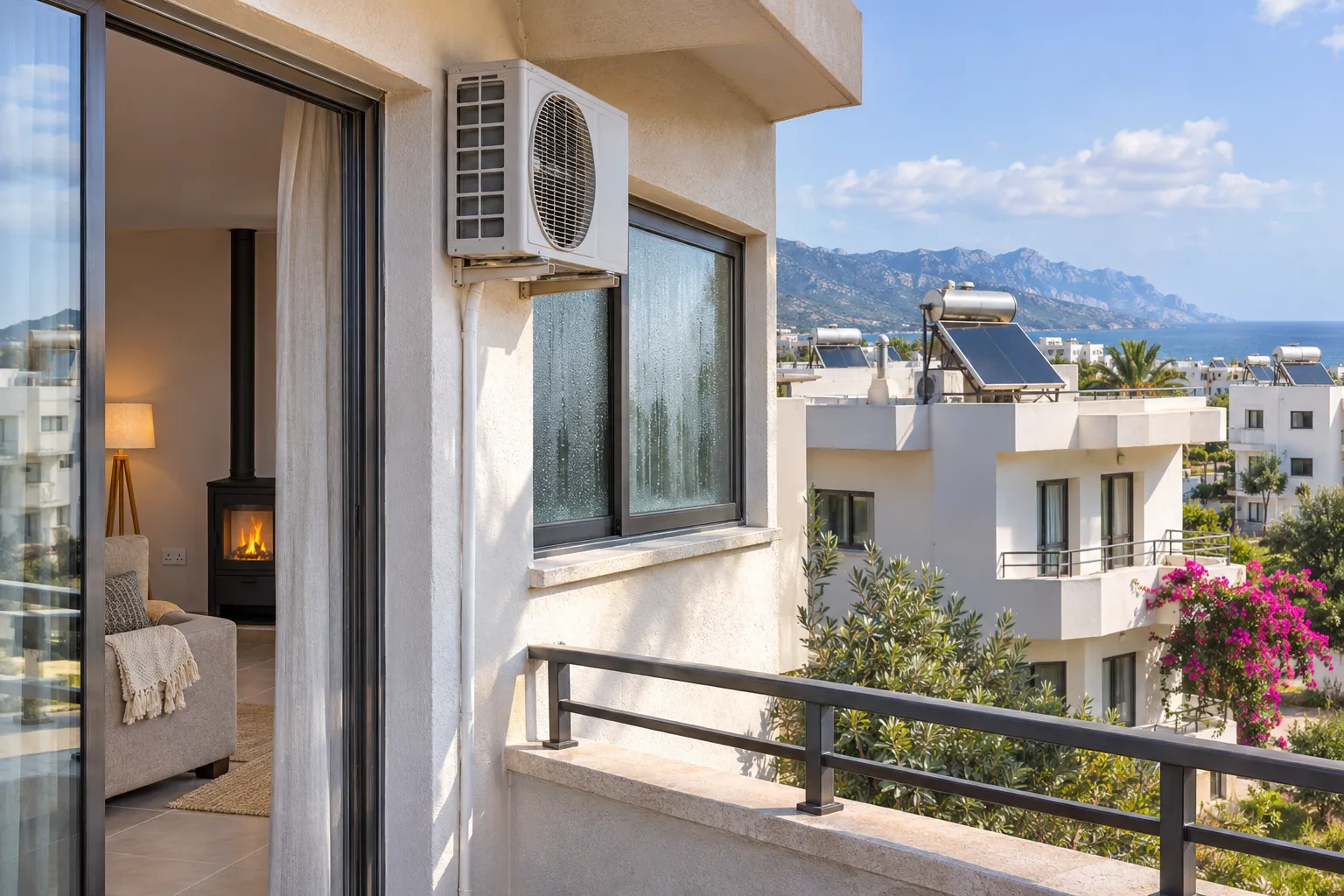
Damp shows itself through visible signs. Water collecting on the window glass in the morning, grey-black patches in the corner of a wall and a musty smell behind a wardrobe are signs of condensation; The EPA also treats condensation on windows, walls or pipes as a sign of high humidity. How to read these signs is covered in detail in signs of damp and mould at home. Before asking “which heater?”, the question to ask is “how does this home get rid of moisture?”
Air conditioning, fireplace, stove or underfloor heating: how do they compare?
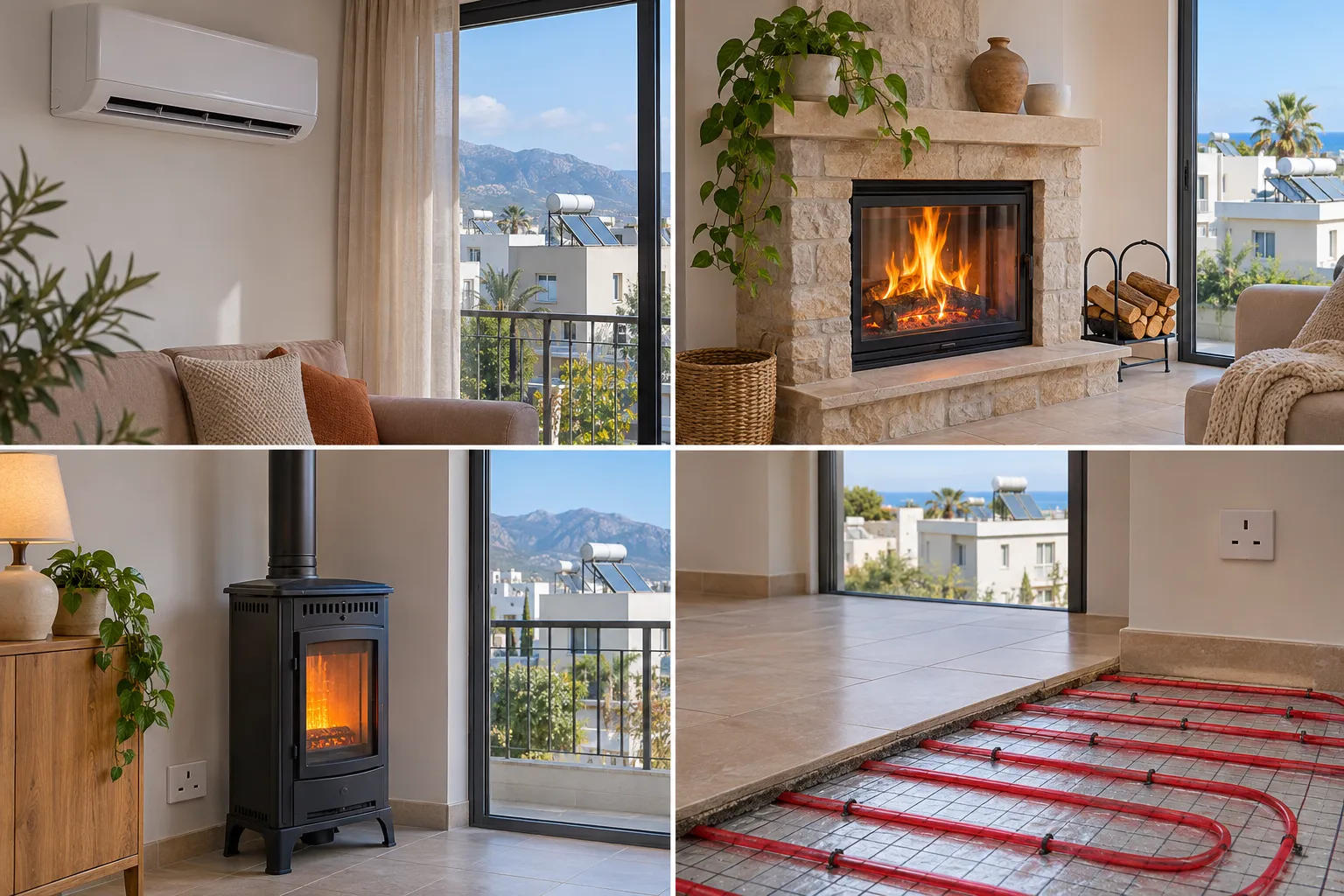
Air conditioning (a heat pump) is already fitted in many homes in Cyprus and both heats and cools; fireplaces and stoves give fast, local heat but need a chimney and ventilation. Underfloor heating gives even, quiet warmth, but it is laid during construction. Whichever system you choose, the home’s insulation and windows should be assessed first.
There is one rule to keep in mind when reading the table: a home works as a whole. The Canadian government’s energy efficiency guide stresses that insulation, airtightness, windows and ventilation work together, and recommends choosing a smaller, efficient heating system after the building envelope has been improved. In a home with single glazing and an uninsulated roof, even a powerful air conditioner cannot keep the heat inside.
Combustion heaters come with a second calculation. According to the EPA, combustion stoves and unvented heaters add water vapour to the room; in an already damp Cypriot home, that vapour comes back as condensation on the glass and mould in the corners. That is why opening the window briefly at intervals in a room with a gas heater should become a habit. With a fireplace or wood stove, the first thing to check is the chimney: a clean chimney with a good draw both improves heating and lowers the fire risk.
Some homes have two systems side by side, for example a fireplace or stove in the living room and air conditioning in the bedrooms. With this setup, the living room stays warm during a power cut, and at night the bedroom air conditioner runs on a timer.
| System | Installation | Pros | Cons |
|---|---|---|---|
| Air conditioning (heat pump) | Indoor and outdoor unit; already fitted in many homes | Heats and cools, starts quickly, no fuel to carry | Depends on electricity and stops in a power cut; consumption goes straight onto the bill, older units are less efficient |
| Fireplace | Needs a chimney; usually built in the living room | Strong, pleasant heat; keeps burning during a power cut | Part of the heat goes up the chimney and does not reach distant rooms; needs wood storage and ash cleaning |
| Stove (pellet, wood, gas) | Pellet and wood stoves need a chimney; gas heaters are portable with a cylinder | Heats quickly; wood and gas models work without mains power | Combustion and unvented models add water vapour indoors; ventilation and fuel storage are needed |
| Underfloor heating | Laid under the floor during construction; electric or water-based | Even, quiet heat; no units on the walls | Hard to add later, slow to warm up, the floor must be opened for repairs |
How do you calculate the monthly heating cost?
Monthly heating consumption is the power the appliance draws (kW) multiplied by the hours it runs each day and the number of days it is used. This kWh is added to the home’s other consumption and priced using the band rates of Kıb-Tek’s 02 residential tariff; In the list valid from 1 June 2026, the unit price for the first 250 kWh is 5.8614 TL and for consumption above 1001 kWh it is 16.8444 TL.
The calculation takes three steps. The first is to find the electrical power consumption written on the appliance’s label or in its manual; for an air conditioner this is the power drawn from the socket, not the heating capacity. That power is then multiplied by the number of hours the appliance runs per day and the number of days it is used per month.
An example with variables: if an air conditioner with a power of P kW runs s hours a day on g days a month, the monthly heating consumption is E = P × s × g kWh. If the home’s non-heating consumption (fridge, the electric immersion heater of the solar water tank or water heater, washing machine) is T kWh, the meter will show T + E kWh at the end of the month.
In Kıb-Tek’s tariff list valid from 1 June 2026 (page dated 28.07.2026), the 02 residential tariff has five bands and a fixed charge of 110.58 TL is added to the bill; the bands and unit prices are in the table. Because the kWh in each band are charged at that band’s own price, the consumption that heating pushes into a higher band costs more than multiplying E by a single price would suggest.
If total consumption does not exceed 250 kWh, the calculation is a single line: (T + E) × 5.8614 TL + 110.58 TL. If the total is between 251 and 500 kWh, the first 250 kWh are charged at 5.8614 TL (250 × 5.8614 = 1,465.35 TL) and the remaining (T + E − 250) kWh at 12.0920 TL; the fixed charge is added on top. Once 500 kWh is exceeded, the third band’s price of 13.0019 TL applies. For a step-by-step guide to reading the band lines and other items on the bill, see how to read a Kıb-Tek electricity bill.
On the three-rate tariff, the unit price between 22:00 and 07:00 at night is below the peak-hour price, so heating at night costs less on this tariff. Because tariffs can change, check the current list from Kıb-Tek before you start calculating.
Inverter air conditioners lower their power once the room has warmed up, so the figure on the label is higher than the average power drawn hour by hour. The quickest way to see real consumption is the same home’s bills from last winter.
Hot water is an item on the bill that is often overlooked. According to the US Department of Energy’s building science resource, in the US water heating accounts for about 20% of a home’s energy use. In Cyprus, on cloudy winter days the electric immersion heater of the solar water tank runs more often, and that consumption goes onto the same meter. The full picture, together with rent and other expenses, is brought together in the real monthly cost of a rental home.
| Tariff and band | Winter hours (1 November–31 May) | Unit price (TL/kWh) |
|---|---|---|
| 02 residential, 0–250 kWh | No time-of-day split | 5.8614 |
| 02 residential, 251–500 kWh | No time-of-day split | 12.0920 |
| 02 residential, 501–750 kWh | No time-of-day split | 13.0019 |
| 02 residential, 751–1000 kWh | No time-of-day split | 14.0933 |
| 02 residential, over 1001 kWh | No time-of-day split | 16.8444 |
| Three-rate, off-peak | 22:00–07:00 | 7.9711 |
| Three-rate, standard | 07:00–17:00 | 12.0920 |
| Three-rate, peak | 17:00–22:00 | 16.7282 |
- P (kW): the electrical power the appliance draws from the socket; shown on the label or in the manual.
- s (hours/day): daily running time; in winter mostly evening and night hours.
- g (days/month): number of days with heating.
- T (kWh): monthly consumption other than heating; read from last winter’s bills.
- Band prices and fixed charge: Kıb-Tek’s current tariff list, together with the date you read it.
How do you make good use of the sun in winter?
The key to using the winter sun is a living area that faces south and a winter sun that travels low across the sky: a correctly sized overhang or balcony lets the sun in during winter and blocks it in summer. Large, double-glazed south windows, a stone or concrete floor that warms up by day and releases heat in the evening, and the right curtain habits all cut the hours the heater has to run.
The first question is which way the home faces. In the northern hemisphere, the winter sun passes low across the southern sky all day. If daytime spaces such as the living room and kitchen face south, there will be days when you never switch the heater on around midday. A home with a blank wall to the south and a living room with wide windows to the north will have a colder winter with the same floor area and the same air conditioner.
The depth of the overhang and balcony is decisive. Low winter sun reaches deep into the room beneath a correctly sized overhang, while the same overhang stops the high summer sun in front of the glass. A very deep balcony keeps the living room cool in summer but leaves it dark and cold in winter, and south glazing with no shade at all turns the room into an oven in summer. The essence of choosing a home in a Mediterranean climate is to think about summer coolness and winter warmth at the same time; the summer side of the overhang is covered in choosing a home that stays cool in summer.
Large glazing on the south side only counts as a gain if it is double glazed. Solar heat that comes in during the day escapes quickly through single glazing at night; double glazing and well-fitted frames reduce that loss. On the north side the situation is reversed: on this sunless facade, small windows limit heat loss. A north-facing bedroom with wide windows is often the coolest corner of the home.
Thermal mass is heavy material that stores the sun’s heat. A sunlit stone or concrete floor warms up during the day and slowly releases that heat into the room in the evening; that is why not covering the floor of a sunny living room with a thick rug makes a difference in winter. In a room that gets no sun, the same mass holds on to the cool.
Habits matter as much as design. South curtains stay open during sunny hours and thick curtains are closed once the sun goes down, so heat gathered during the day does not escape through the glass at night. Keeping curtains closed all day in north rooms also helps.
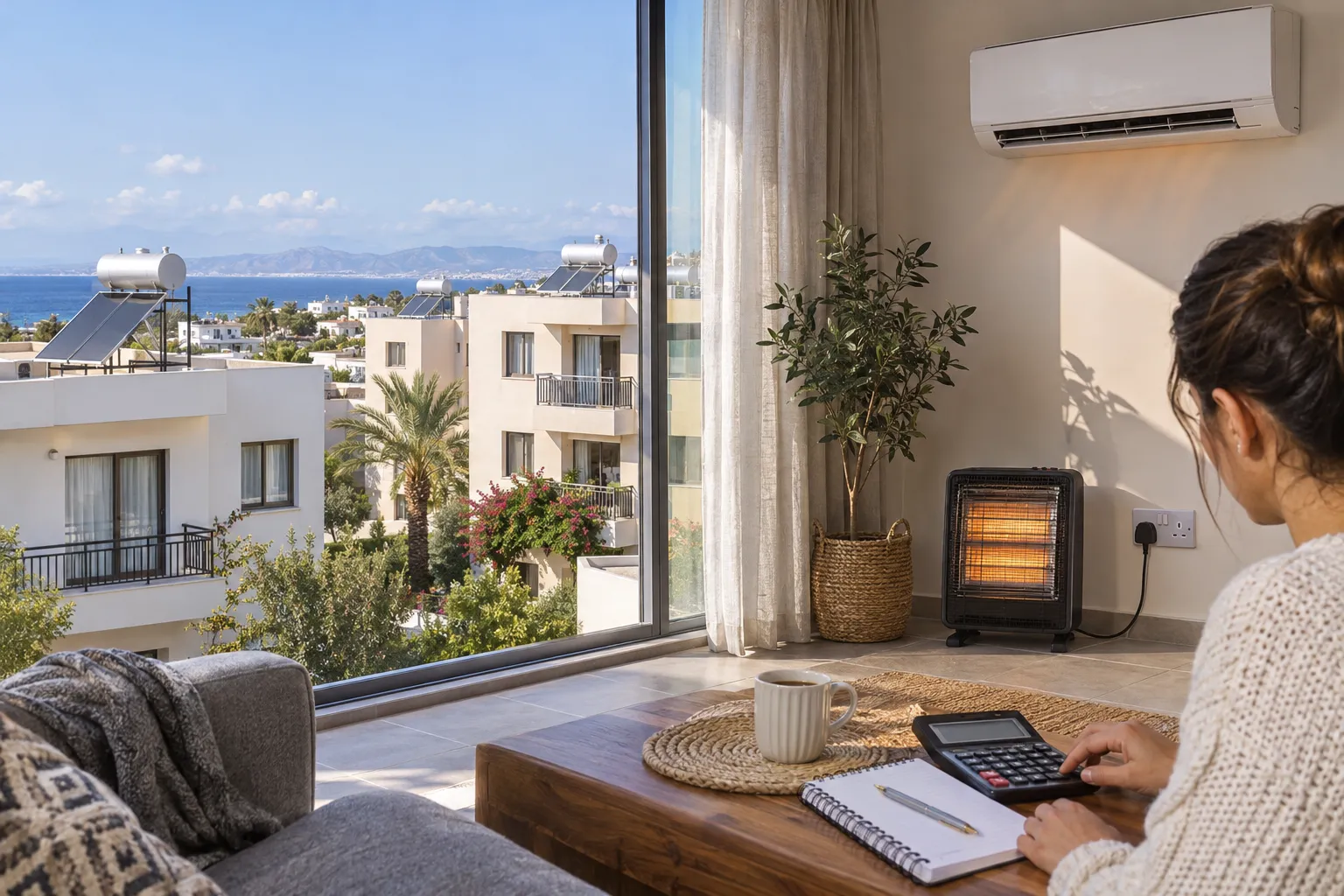
Rooftop solar systems work in winter too, just not at their summer pace. The US Department of Energy’s building science resource states that passive thermosiphon solar water heating systems suit warm coastal climates and that, in the northern hemisphere, the collector should be placed on an unshaded, south-facing roof. In Cyprus, on sunny winter days the solar water heater often covers hot water needs; on several cloudy days in a row, its electric immersion heater kicks in. Rooftop solar panels show a similar picture: because winter days are short and the sun is low, output is lower than in summer. Whether the collector or panel sits in shade at midday, or whether a neighbouring building that went up later now blocks the roof, is clear at first glance.
The way to see all this is to view the home at midday. On an evening visit the rooms look alike; at midday in winter it becomes obvious how far the sun reaches into the living room and which room gets no light at all.
- Use the compass on your phone to note which way the living room and bedroom windows face.
- Look at the furthest point the sun reaches on the floor: does the overhang let the light in or cut it off?
- Check whether the south glazing is double glazed by looking for the gap between the panes at the edge.
- In north-facing rooms, check the size of the windows and the corners of the walls.
- See whether the rooftop collector or panel is in shade at midday.
- Ask the owner which rooms get sun in the morning and in the evening.
- Roof and insulation
- Overhang or balcony
- South glazing (double glazed)
- Thick curtains
- Stone or concrete floor
- North facade
What should you check when viewing a home?
The things that decide how warm a home stays in winter do not show in listing photos; they have to be checked on site. First come the type, capacity and age of the air conditioning; then the wall and roof insulation, whether the windows are double glazed and what the frames are made of. North-facing rooms, signs of damp and mould, the chimney and the capacity of the electrical wiring complete the list.
The Canadian government’s energy efficiency guide advises checking the age and condition of the heating system and, in older homes, inadequate wiring. Weak wiring gives itself away most on winter evenings when several air conditioners run at once. Ways to prepare a home for outages are gathered in a home ready for power cuts.
The list is the same for buyers; only the weight shifts: a tenant spends one winter here, while a buyer lives with the same walls for years.
- Air conditioning: inverter or fixed speed; in every room or only the living room; year of manufacture and capacity on the outdoor unit’s label.
- Heating per room: a single living-room air conditioner does not reach bedrooms with closed doors.
- Roof insulation: on the top floor or in a detached house, stains on the ceiling point to missing insulation or waterproofing.
- Wall insulation: if the inside face of an outer wall is noticeably cold and there are stains in the corners, heat loss is high.
- Windows: double glazing, PVC or insulated aluminium frames; do the seals sit tight when closed, is air coming in at the edges.
- North side: how many rooms face this way and how big their windows are.
- Damp and mould: behind wardrobes, bathroom ceilings, window sills; fresh paint may be covering an old mark.
- Chimney: if there is a fireplace or stove, its cleanliness, draw and outlet on the roof.
- Electrical wiring: does the fuse trip when two or three air conditioners and the electric immersion heater of the solar water tank or water heater run together.
What should you ask the landlord as a tenant?
The most useful document for a tenant is last winter’s electricity bills; they show the home’s real heating cost in figures. Beyond that, discuss who owns the air conditioners and stove and who handles their maintenance. If it is agreed in writing before signing the contract who to tell when damp or mould appears, arguments in the middle of winter can be avoided.
The EPA recommends reporting leaks without delay and drying wet areas within about 24–48 hours; mould needs moisture to grow. A stain that appears on the ceiling after the first winter rain turns, if left, into mould spreading behind the wardrobe.
The word “air-conditioned” in rental listings leaves the questions of how many rooms, what type and which year unanswered; the landlord has those answers.
Once the questions are clear, it helps to add the agreed split to the contract in a single line. A clear sentence such as “Cleaning the air conditioner filters is the tenant’s responsibility; repairing faults is the landlord’s.” settles from the start who deals with an air conditioner that breaks down in January.
- Kıb-Tek bills for last December, January and February, and how many people lived in the home at the time.
- Who owns the air conditioners; who handles filter cleaning and repairs.
- If there is a fireplace or stove, when the chimney was last cleaned.
- Who supplies fuel such as wood, pellets or gas cylinders.
- Whether the electric immersion heater of the solar water tank or water heater works.
- Who to report damp, leaks or mould to, and how.
- How the home is heated during a power cut.